
Restaurant Seating Request: Describe Access and Space
On this page
- Separate a request from a guarantee
- Describe the need clearly
- Ask about the route to the table
- Check table and chair details
- Plan space for mobility devices
- Consider sound, light, and sensory needs
- Coordinate children and high chairs
- Manage large parties
- Reconfirm before arrival
- Respond when the table is not suitable
- Seating request checklist
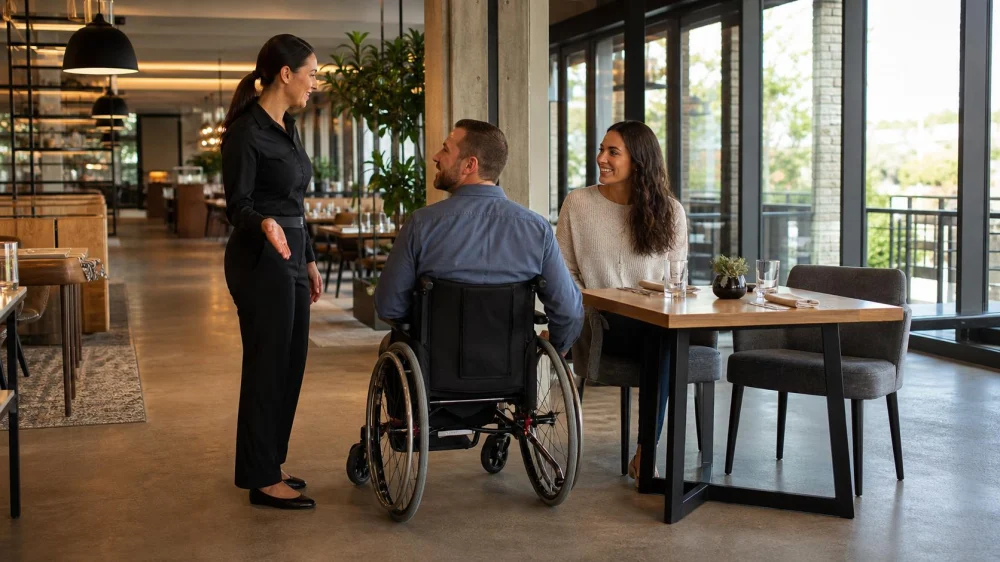
A restaurant seating request works best when it explains the practical need instead of naming only a favorite area. “A step-free route with space beside the table for a wheelchair” gives staff more useful information than “the best table.” Clear details help the restaurant match its actual layout, reservations, and service plan.
Contact the specific location because floor plans, entrances, furniture, patios, and policies vary. A request may depend on table availability and cannot always be guaranteed, but disability-related access needs may carry legal obligations. Ask early, document the confirmation, and use official local accessibility guidance when rights or responsibilities are unclear.
Benares Tribeca Indian Restaurant / benares nyc
New YorkNew York CountyNew York
45 Murray St, New York, NY 10007, USA
Separate a request from a guarantee
Restaurants often record preferences such as a booth, window, patio, quiet corner, or area away from the kitchen. Busy service, weather, closures, and party timing can change what is available. Ask whether the note is a preference, confirmed arrangement, or accessibility accommodation.
Record the name or department that confirmed an essential arrangement and the time of the call. Avoid assuming that a note entered through a third-party booking app reached the host. For a material need, contact the restaurant directly and invite staff to explain any limitation before arrival.

Laissez Faire / laissez faire new york
New YorkNew York CountyNew York
10 Theatre Alley, New York, NY 10038, USA
Describe the need clearly
State the party size, date, time, and exact functional requirement. Examples include step-free entry, a chair rather than a backless stool, space for a mobility device, seating away from flashing screens, or a table that allows a support person to sit adjacent.
Share only the personal information needed to arrange the table. A diagnosis is often less useful than describing space, route, height, or communication needs. Ask what the restaurant can provide and repeat the final arrangement to avoid different interpretations.
Ask about the route to the table
Check the path from parking, drop-off, sidewalk, or transit stop through the correct entrance to the host stand and table. Ask about steps, thresholds, ramps, door width, elevators, floor surfaces, and narrow turns. A dining room described as accessible may use a different entrance.
Also ask about the route to the restroom and payment area. Outdoor tables can require crossing gravel, grass, curbs, or slopes. Construction, seasonal furniture, and private events may temporarily change an otherwise familiar path.
Check table and chair details
Furniture height and structure matter. A central pedestal, fixed booth, closely spaced legs, communal bench, bar-height surface, or heavy chair may not suit every diner. Ask whether staff can reserve a standard-height table and removable chair when needed.
Do not move heavy restaurant furniture yourself. Staff must maintain aisles and emergency routes. If a seat requires extra cushions or support, ask what is available and whether a personal item can be used safely without slipping.
Plan space for mobility devices
A wheelchair, walker, cane, crutches, or service animal should not be placed where it blocks the user's movement or creates an aisle hazard. Explain whether the diner transfers to a chair or remains in the device. Ask staff to preserve the requested clear space.
Mobility devices should stay within reach unless the user directs otherwise. If a restaurant proposes storage, clarify who will move the device and how it can be returned immediately. Never lean a cane or crutches where they can fall into a walkway.
Consider sound, light, and sensory needs
Ask about speakers, live music, kitchen pass, bar, televisions, sunlight, scented displays, and busy server routes. A “quiet table” is relative, so describe whether conversation, reduced glare, lower foot traffic, or distance from music is the priority.
Timing can be as important as location. An earlier reservation may offer lower volume and more table choice, though the restaurant should confirm typical conditions. Bring approved personal supports when helpful and safe, but do not block service or emergency paths.
Coordinate children and high chairs
Include infants and children in the party count. Ask whether the restaurant has high chairs, booster seats, stroller space, changing facilities, and age restrictions. A stroller cannot be assumed to fit beside a table or remain open in a narrow aisle.
Inspect restaurant-provided child seating before use and secure it according to its design. Do not place a carrier on an unstable chair, tabletop, or overturned high chair. Keep hot drinks, sharp utensils, and service trays beyond a child's reach.
Manage large parties
For a large group, share the final headcount, wheelchair or high-chair spaces, and whether guests must remain together. The restaurant may use several adjacent tables, a fixed menu, deposits, or a private room. Ask how late arrivals affect seating.
Create a simple place plan only when it serves a real need. Avoid reserving unnecessary empty seats. Tell the organizer and restaurant about essential arrangements without broadcasting private health details to the entire group.
Reconfirm before arrival
Contact the restaurant on the day or shortly before, especially when the arrangement is essential, weather affects a patio, or the booking was made weeks ago. Confirm the location, entrance, party count, time, table requirement, and name on the reservation.
Share an updated arrival time and ask where a driver should drop off. Arrive within the stated grace period. Bring the confirmation message if available, but remain prepared for staff to adjust the exact table while preserving the required function.
Respond when the table is not suitable
Pause before the party settles and explain the mismatch to the host: the route has a step, the chair is fixed, the device does not fit, or the noise is greater than discussed. Ask for the manager or accessibility contact when necessary and focus on a workable alternative.
Do not create a dangerous workaround by blocking an exit, lifting a person without consent, or balancing equipment. If the restaurant cannot provide a safe essential arrangement, document the facts and decide whether to wait, use takeout, or leave. Formal accessibility concerns can be directed to the appropriate business or local authority.
Seating request checklist
Confirm the exact restaurant, date, time, party count, entrance route, table height, chair type, clear floor space, restroom route, sensory conditions, child seating, service-animal space, and contact name. Distinguish confirmed accommodations from preferences.
A precise seating request gives staff a problem they can solve. Describe the function, ask about the full route, and reconfirm material details. This approach supports a safer arrival and a more comfortable meal without assuming that every table or dining room works the same way.





 Hanco's4.0 (549 reviews)
 Vincent's4.0 (662 reviews)
 Burgerz0.0 (0 reviews)
 Q Grill | Korean BBQ & Seafood in Fort Lee, NJ4.0 (238 reviews)
 King3deli grocery4.0 (8 reviews)
 Tabare Williamsburg4.0 (1039 reviews)
 Exploring Middle Eastern Restaurants That Offer Interactive Dining Experiences
 How to Find the Best Dining Deals Near Me: Where to Eat Without Breaking the Bank
 Best Burger Joints with Truffle Fries Near Me: A Gourmet Twist on a Classic Meal
 How Breakfast Restaurants Are Offering Seasonal Dishes With Unique Ingredients
 Exploring Middle Eastern Restaurants That Feature Interactive Dining Experiences
 Discovering Breakfast Restaurants That Offer Innovative Brunch Combos