
Counter Service vs Table Service: What Changes for Diners?
On this page
- Quick answer
- Define the two service styles
- Know what to do when you arrive
- Compare how ordering works
- Clarify seating and table use
- Track pickup, delivery, and missing items
- Handle refills, extras, and second orders
- Understand payment and receipts
- Plan for accessibility and groups
- Service-style checklist
- Frequently asked questions
- Sources and evidence notes
- Conclusion and next steps
Quick answer
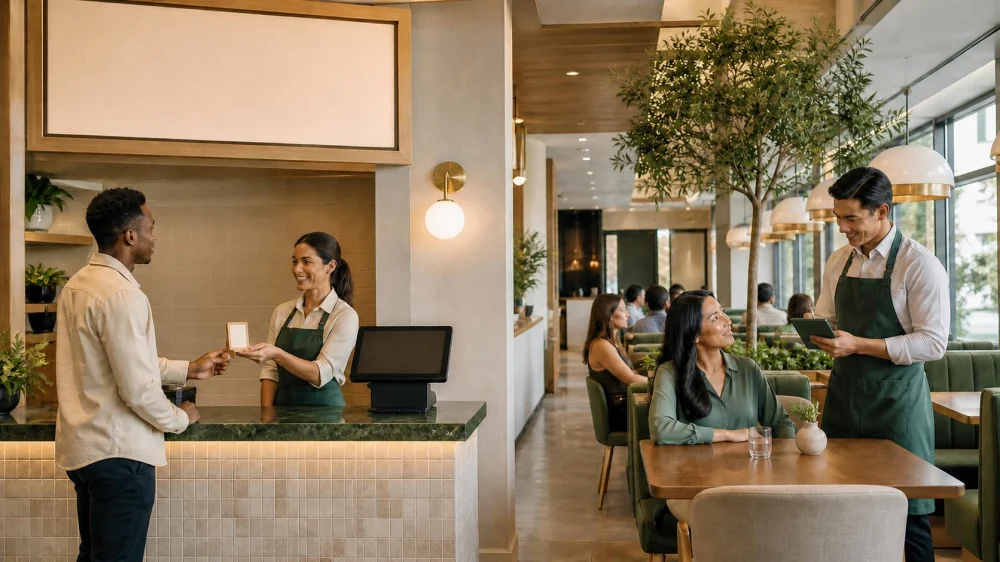
At counter service, diners usually order and often pay at a register, kiosk, window, or counter, then carry food or receive a number for delivery. At table service, a host or server usually manages seating, ordering, course timing, additions, and payment at the table. Many restaurants blend the two. On arrival, check whether to seat yourself, wait for a host, order first, collect utensils, pick up food, clear the table, and request the check.
This US dining guide describes common patterns, not guaranteed service. Cafés, food halls, fast-casual restaurants, bakeries, bars, hotels, and full-service restaurants set their own flow, accessibility process, fees, and gratuity practices.
Define the two service styles
Counter service means the guest places the order at a fixed ordering point rather than through a server assigned to the table. Payment commonly happens with the order, and the guest may collect food, drinks, utensils, and condiments.
Table service means an employee takes the order and manages service at the guest’s table. Payment commonly happens near the end, although some restaurants use handheld devices or advance payment.
Hybrid service combines elements. You might order at the counter, receive entrées at the table, refill drinks yourself, and close a tab through a QR code. The restaurant’s signs and staff directions matter more than the category label.

Chocolate House Astoria / chocolate house astoria
25-88 Steinway St, Astoria, NY 11103, USA
Know what to do when you arrive
Pause inside the entrance and look for a host stand, order line, “seat yourself” process, table-number display, or employee greeting. Do not walk past a waiting line or occupy a reserved table before understanding the flow.
Useful questions include:
- Should we order before choosing a table?
- May one person hold a table while another orders?
- Do you seat groups only when everyone is present?
- Where is accessible seating and the accessible ordering point?
- Is this line for dine-in, takeout, pickup, or all orders?
At a food hall, each vendor may have a separate order and pickup process while seating is shared.
Compare how ordering works
At a counter, review the menu before reaching the register when possible. State dine-in or takeout, item, size, options, sides, beverage, and allergy questions clearly. Listen while the employee repeats the order and check the display before paying.
At a table, the server may explain specials, take beverage orders first, and return for food. Ask how courses are paced and whether all items should be placed together. A server can coordinate the table, but diners still need to state allergies and essential preferences plainly.
A kiosk or app is still a counter-style order channel. Review quantity, modifiers, table number, pickup location, tip or service-charge screen, and final total before submitting. Ask an employee for help rather than choosing an unsafe allergy assumption.
Clarify seating and table use
Counter-service seating may be first-come, assigned by a host, or linked to a table number. Some restaurants ask guests to order before taking a table so seating turns with the kitchen queue. Others want a group member seated so food runners can locate the party.
At table service, wait to be seated unless staff explicitly says otherwise. A visibly empty table may be reserved, awaiting cleaning, outside a server’s open section, or unsuitable for the party size.
Keep bags, strollers, mobility devices, and chairs out of aisles and emergency paths. Ask before combining or moving tables.
Track pickup, delivery, and missing items
Counter restaurants may call a name, show an order number, vibrate a pager, send a message, place food on a pickup shelf, or run it to the table. Confirm which signal to watch and whether drinks come from a separate station.
At pickup, compare the receipt with containers without opening another guest’s order. Ask staff to resolve a missing or wrong item before carrying everything away. Do not reach behind the counter or take an unverified package.
At table service, tell the server promptly if one item is missing, incorrect, unsafe for an allergy, or much later than the rest. Pause before eating a questionable dish so staff can identify and replace it.
Handle refills, extras, and second orders
Self-service stations may provide water, fountain drinks, utensils, napkins, condiments, or takeout containers. Use clean shared utensils, take only what is needed, and follow refill rules. Ask before filling a personal bottle or moving restaurant containers.
For a second counter order, keep the table marker and original receipt if it helps staff combine or locate orders. The addition may start a separate preparation time.
At table service, request additions through the assigned server when possible so the order reaches the correct check and table. Do not assume a refill, sauce, bread basket, or substitution is free; ask about price when it matters.
Understand payment and receipts
Counter service commonly collects payment before preparation. Confirm the amount, card return, receipt, order identifier, and any open tab. Keep the receipt until every item arrives.
Table service commonly presents a check after the meal. Review items, service charges, discounts, deposits, and tax before paying. If splitting, ask about the restaurant’s policy before everyone orders, not after cards are placed down.
Gratuity customs and service charges vary by restaurant, location, and service provided. Read the receipt and disclosed policy. A screen’s suggested amount does not replace checking whether a mandatory charge is already included.
Plan for accessibility and groups
A long counter line, high ordering surface, small-print menu, noisy pickup call, heavy tray, or distant self-service station can create barriers. Ask staff for available accessible ordering, seating, menu, communication, tray-carrying, or table-delivery assistance.
Groups should decide who orders, how names or numbers identify meals, and where everyone waits. One person can collect dietary needs and modifiers, but the individual with an allergy should communicate directly when possible.
For children, mixed-age groups, or anyone needing more time, choose a quiet place to review the menu before approaching the counter. Do not block the active line while organizing a large order.
Service-style checklist
- Wait for host, seat yourself, or order first clarified
- Dine-in, takeout, and pickup lines distinguished
- Order channel and payment timing understood
- Allergy and essential modifier process confirmed
- Table number, pager, name, or pickup signal saved
- Drinks, utensils, condiments, and refills located
- Missing-item contact point identified
- Second-order and split-check process understood
- Service charges and receipt reviewed
- Table-clearing expectation checked
Frequently asked questions
Should I find a table before ordering at counter service?
Ask the restaurant. Some want guests to order first, while others use table numbers or encourage one person to sit. Do not reserve a large table with belongings without permission.
Does counter service mean I carry my own food?
Not always. Some restaurants run food to the table after a counter order. Confirm the pickup signal and table-number process.
Do I clear my table?
Look for tray-return or waste stations and follow posted directions. If unclear, ask staff rather than leaving dishes in the wrong place or entering a work area.
Is a service charge the same as a tip?
Not necessarily. Read the restaurant’s disclosure and receipt and ask how the charge is described. Rules and practices vary by location.
Sources and evidence notes
Counter, table, and hybrid service are operating models rather than nationally standardized promises. The workflows in this guide reflect common hospitality practice, while seating, ordering, payment, gratuity, accessibility assistance, refills, and table clearing are determined by the restaurant and applicable law. Guests should use current staff direction and disclosed policies.
Conclusion and next steps
The main difference is who carries each step of the service process. Counter service shifts more ordering, pickup, and station tasks to the diner; table service assigns more coordination to a server; hybrids divide the work. On arrival, identify how to sit, order, receive food, request additions, pay, and clear. Five seconds of observation or one clear question can make the whole meal smoother.






 Gloria's Bar And Grill3.0 (526 reviews)
 Cherry Valley Deli & Grill4.0 (1190 reviews)
 Wallys bagel nosh4.0 (40 reviews)
 The Blue Room Speakeasy5.0 (4 reviews)
 Panda Harlem3.0 (463 reviews)
 Anas smoothies0.0 (0 reviews)
 How to Find the Best Gluten-Free Pizza Near Me: A Slice of Heaven Without the Gluten
 Finding the Best Clam Chowder Near Me: New England vs Manhattan Style
 How to Evaluate Restaurant Allergy Practices Before You Dine
 The Top Food Trends to Watch in 2025: What’s Hot in Restaurants Near You
 Discovering the Best Fine Dining Restaurants for Romantic Evenings
 Best Chocolate Chip Cookies Near Me: Where to Find the Best Soft and Gooey Cookies