
Restaurant Leftovers: Pack, Chill, and Reheat Them Safely
Quick answer
Ask for a clean container before restaurant leftovers spend too long at the table, then refrigerate perishable food within two hours—or within one hour when the surrounding temperature is above 90°F. Use a cooler for a long or hot trip, store food in shallow covered containers, and reheat leftovers to 165°F measured with a food thermometer.

Decide before the meal lingers
The time food spends on the table counts. If you expect to take part of the meal home, ask for a box when you finish eating rather than after a long conversation, event, or second destination. Foods containing meat, poultry, seafood, eggs, dairy, cooked rice or pasta, cut produce, gravy, and many sauces require temperature control.
Skip leftovers when you cannot refrigerate them in time. Smell and appearance cannot confirm that food held too warm is safe. Reheating also does not reliably reverse every hazard created by improper holding.

Black Forest Brooklyn - Fort Greene / black forest brooklyn fort greene
733 Fulton St, Brooklyn, NY 11217, USA
Pack food cleanly
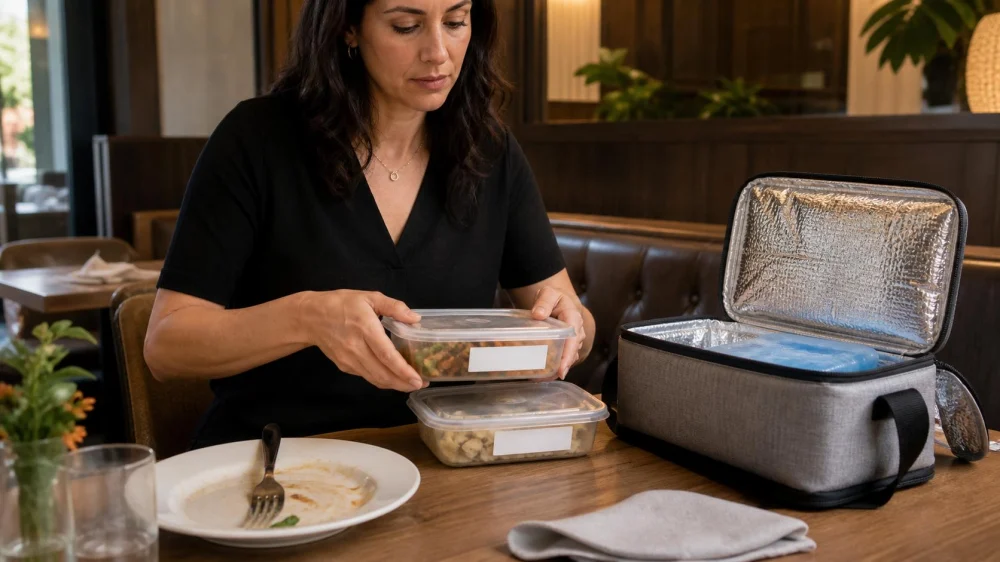
Use a clean, food-grade container with a secure lid. Keep raw garnishes or rare meat juices from dripping onto ready-to-eat items. Separate sauces, crisp toppings, and delicate greens for quality, and divide a large amount into smaller portions so it can cool more quickly.
Label the container with the dish and date when it may be confused at home. If someone has a food allergy, do not combine dishes or sauces, and remember that restaurant cross-contact may already be possible. Ask staff about ingredients before deciding to keep the food.
Start the safety clock
USDA guidance says perishable leftovers should be refrigerated within two hours. When the temperature is above 90°F, such as on a hot patio or in a warm car, the limit is one hour. Count total time outside safe hot or cold holding, including the table, checkout, travel, and errands.
Do not reset the clock by briefly putting a box near air conditioning or adding it to a room-temperature bag. If you do not know how long a perishable dish has been out, the safer choice is to discard it.
Plan the trip home
- Go directly to a refrigerator when the trip fits within the safe window.
- For a longer or hot trip, use an insulated cooler with sufficient ice or frozen gel packs.
- Keep the cooler in the air-conditioned passenger area, not a hot trunk.
- Separate leak-prone containers and keep lids upright.
- Do not leave leftovers in a parked vehicle while shopping or attending another event.
A bag protects the car from spills but is not necessarily an insulated cooler. Check food with a thermometer when temperature control is uncertain rather than relying on how cool the box feels.
Refrigerate promptly
Put food in the refrigerator as soon as you arrive. USDA advises a refrigerator temperature of 40°F or below. Shallow containers help food cool more rapidly than a deep, tightly packed mass. Do not crowd the refrigerator so densely that cold air cannot circulate.
Most cooked leftovers are generally used within three to four days under USDA guidance. Freeze sooner when you will not eat them in that period. Mark the date and use an orderly first-in, first-out system. Freezing pauses bacterial growth but does not repair food that was mishandled before freezing.
Reheat thoroughly
Reheat leftovers to an internal temperature of 165°F. Measure the center and thickest parts with a clean food thermometer, checking more than one spot in a dense or uneven dish. Bring soups, sauces, and gravies to a rolling boil as USDA advises.
In a microwave, cover food, rotate or stir it, and allow standing time so cold spots heat. Use only microwave-safe containers; many restaurant boxes are intended for transport, not heating. Reheat only the portion you plan to eat to protect quality and reduce repeated cooling cycles.
Know when to discard
Discard perishable food that exceeded the two-hour limit, or one hour above 90°F; food from a leaking, swollen, or damaged container; leftovers with mold or an unexpected odor or texture; and any item whose history is uncertain. Do not taste a bite to test safety.
Some quality changes—such as soggy breading or wilted greens—are not necessarily unsafe, but time and temperature still decide whether the food should be kept. When in doubt, throw it out.
Leftover checklist
- Clean, leak-resistant container obtained promptly
- Dish and packing time remembered or labeled
- Total table and travel time remains within the limit
- Cooler and ice packs used for long or hot transport
- Food placed in a 40°F-or-below refrigerator
- Large portions divided into shallow containers
- Use-by plan set within three to four days or food frozen
- Reheated portion reaches 165°F by thermometer
Limitations and higher-risk diners
This guide is general U.S. food-safety information. Local requirements and restaurant procedures may differ. Pregnant people, adults 65 and older, children under five, and people with weakened immune systems face higher risk from foodborne illness and should follow clinician and public-health guidance. Some foods may be poor leftover candidates even when handled safely because texture degrades.
Sources and evidence
The U.S. Department of Agriculture Food Safety and Inspection Service’s “Leftovers and Food Safety” guidance supplies the core limits used here: refrigerate within two hours, or one hour above 90°F; keep the refrigerator at 40°F or below; use most cooked leftovers within three to four days; and reheat leftovers to 165°F. Check the current USDA page for updates.
Frequently asked questions
Can I run errands with the leftovers in the car?
Only if proper cold holding keeps the food safe and the total time limit is controlled. A parked car heats quickly, so the best plan is to refrigerate first.
Can I put a warm box directly in the refrigerator?
Prompt chilling matters. Divide large amounts into shallow containers so they cool efficiently and avoid overloading the refrigerator.
How long are restaurant leftovers good for?
USDA generally advises using cooked leftovers within three to four days when they were handled and refrigerated safely. Freeze sooner if needed.
Is steaming hot enough without a thermometer?
Steam is not a precise measurement, especially for uneven dishes. Use a food thermometer and verify 165°F in the coldest or thickest areas.
Can salad be reheated?
Many salads are served cold and do not reheat well. The ingredients still need prompt refrigeration, and a salad exposed too long should be discarded rather than “fixed” by heating.
Conclusion
Safe restaurant leftovers depend on decisions made before the box reaches home. Pack cleanly, track total time, use a cooler when necessary, refrigerate promptly in shallow containers, and plan to eat or freeze the food. When reheating, verify 165°F. If time, temperature, or handling is uncertain, do not gamble on a taste test.






 Carnitas los Jarochos4.0 (19 reviews)
 Yopcity restaurant4.0 (294 reviews)
 Father Knows Best4.0 (1176 reviews)
 Gyro Uno Pizzeria4.0 (347 reviews)
 Santini Seafood and Steakhouse4.0 (358 reviews)
 Double Dragon Restaurant3.0 (177 reviews)
 How Ice Cream Shops Are Pioneering Seasonal and Global Flavor Combinations
 Where to Find the Best Sushi Rolls Near Me: A Guide to the Best Sushi in Town
 The Appeal of French Restaurants for Special Occasions
 A Complete Guide to Finding Czech Restaurants Near Me Serving Svickova Fried Cheese and Traditional Pork Knuckle
 How Vegan Restaurants Are Blending International Dishes With Local Ingredients
 The Best Lamb Vindaloo Near Me at Indian Restaurants With Spicy Vinegar Based Curry That Packs Heat