
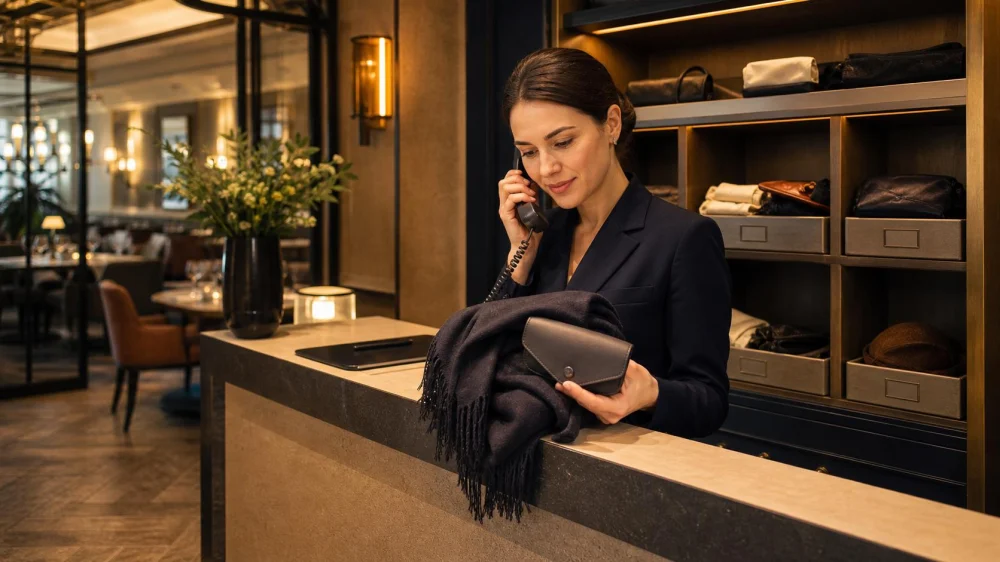
Lost Something at a Restaurant? Call With Useful Details
Table of contents
Quick answer
Call the restaurant through its verified website or receipt and give the visit date, approximate time, reservation name, table or area, item type, color, material, and one nonpublic identifying feature. Secure lost cards, phones, keys, or IDs immediately instead of waiting for a callback. Ask how long items are held, who may collect yours, and what proof the restaurant requires. Record the staff member and follow-up time.

La Tête d'Or by Daniel / le tete d or
New YorkNew York CountyNew York
318 Park Ave S, New York, NY 10010, USA
Secure cards, phones, and sensitive items first
Some losses need action before the restaurant search. Report a missing credit, ATM, or debit card to the issuer promptly using the official banking app or a verified phone number. The U.S. Federal Trade Commission emphasizes acting quickly because protections can depend on the card type and reporting time.
Use the device maker's official lost-device tools for a phone, tablet, watch, or laptop. Lock the device, protect associated accounts, and avoid erasing it until you understand whether erasure will end location tracking. For keys paired with an address, access badge, government ID, passport, medication, or work device, contact the appropriate issuer, employer, property manager, police, or other authority as the risk warrants.
Do not wait hours for a restaurant shift change before taking those protective steps.

Lhasa Snack Cafe / lhasa liang fen
69-11C Roosevelt Ave, Woodside, NY 11377, USA
Reconstruct the visit
Write a short timeline before calling:
- restaurant location, visit date, arrival, and departure window;
- reservation name, party size, and approximate table or bar seat;
- coat check, restroom, waiting area, patio, counter, or valet use;
- when you last remember handling the item; and
- the route taken after leaving.
Check bags, coat linings, vehicle seats, rideshare receipts, and the next destination. Ask companions to inspect their belongings. This narrows the search and avoids asking restaurant staff to scan an entire dining room for an item that is already in the car.
Use the restaurant's official contact
Call the location where you dined, not merely the chain's national line. Obtain the number from the restaurant's verified website, reservation confirmation, or physical receipt. Be cautious with a search advertisement or message claiming the item was found and requesting payment.
Call outside the busiest meal period when practical. Ask for the host, manager, coat check, or person responsible for lost property. If voicemail is the only option, leave a concise description and a safe callback number; do not include card numbers, passwords, PINs, or a home address.
Describe the item without oversharing
Start broadly, then provide one or two features only the owner is likely to know. For example: “a dark wool scarf with a small repaired corner,” or “a black glasses case with blue frames inside.” Let staff compare the description instead of telling you every item they hold.
For a wallet, describe the outside color, material, closure, and one non-sensitive contents category. Do not recite full card numbers, ID numbers, or account details. For electronics, provide model, case color, wallpaper description, or partial serial information; never give an unlock code so someone can “verify” it.
Arrange a verifiable pickup
Ask the restaurant to confirm the location, pickup hours, retention deadline, and required proof. Get the name or department holding the item and, if offered, a reference note. Bring identification that does not require surrendering unnecessary personal data.
If another person will collect it, authorize them through the restaurant's stated process and tell them what proof to bring. For shipping, confirm the policy with a manager, use a trackable method, and understand costs and liability. Do not send gift cards, cryptocurrency, a wire transfer, or an account verification code to an unknown caller claiming to hold the item.
Follow up when there is no immediate match
The table may not have been cleared, the closing team may have logged the item later, or another department may hold it. Ask when the next reasonable check will occur and whether the restaurant keeps a lost-property log. One scheduled follow-up is more useful than repeated calls during service.
When the item may have been stolen, contains regulated or sensitive property, or has substantial value, ask local law enforcement or the relevant issuer about reporting. Preserve receipts, location history, serial numbers, messages, and the names and times of contacts. Do not confront staff or other diners based solely on a location-app dot.
Lost-item call checklist
- Sensitive accounts, cards, devices, and keys are secured first.
- The restaurant location and official phone number are verified.
- Date, time, table area, reservation name, and route are noted.
- The description includes a nonpublic identifying feature.
- No PIN, password, verification code, or full account number is shared.
- Staff name, call time, and next check time are recorded.
- Pickup identity, authorization, hours, and retention period are confirmed.
- Shipping or payment requests are independently verified.
Limits and security cautions
This article offers general consumer guidance, not legal, banking, insurance, or identity-theft advice. Lost-property laws, restaurant policies, retention periods, liability, and reporting procedures vary. The restaurant may be unable to confirm an item by phone or may transfer it to another party.
Use official issuer and government instructions for financial cards, passports, driver's licenses, medication, weapons, work property, and identity documents. Report unauthorized transactions or identity theft promptly. In an immediate safety emergency, contact local emergency services.
Frequently asked questions
Should I wait for the restaurant before freezing a lost card?
No. Report the loss or use the issuer's official card controls promptly, then continue the restaurant search. Financial protection can depend on how quickly you act.
Can the restaurant ask for identification at pickup?
Yes, a reasonable verification process helps prevent release to the wrong person. Ask what is required before traveling and avoid sharing more data than necessary.
What if someone texts that they found my wallet?
Verify through the restaurant's official number. Do not share account details, send an upfront reward, or provide a one-time verification code to the texter.
How many times should I call?
Call promptly, then agree on a specific follow-up after staff have checked the relevant areas and shift log. Repeated calls during a rush rarely improve the search.
Consumer and primary sources
- U.S. Federal Trade Commission: Lost or Stolen Credit, ATM, and Debit Cards
- IdentityTheft.gov: When Information Is Lost or Exposed
- The restaurant's verified contact, current lost-property policy, visit receipt, and reservation record are the primary sources for a specific search.
Conclusion and next steps
Protect the sensitive part of the loss first, then make the restaurant search easy to act on. A verified phone number, short timeline, precise nonpublic description, and scheduled follow-up give staff a real chance to match the item without exposing more personal information.






 Sabor Dominicano4.0 (103 reviews)
 Dunkin'3.0 (197 reviews)
 Sushi King4.0 (174 reviews)
 CakeBurgers4.0 (261 reviews)
 Fred's Meat & Bread by Wonder2.0 (28 reviews)
 Auntie Anne's4.0 (5 reviews)
 The Best Food and Wine Pairings at Restaurants Near Me: Expert Tips for a Perfect Match
 How Ice Cream Shops Are Using Seasonal Ingredients to Stand Out
 Best Middle Eastern Restaurants for Seasonal Specials and Unique Flavors
 Discovering French Restaurants That Offer Authentic Regional Cuisine
 Best Taco Bars Near Me: Where to Get the Most Flavorful Tacos in Town
 Best Local Wine Bars Near Me: Sip Local Wines in Great Atmospheres