
Restaurant Accessibility: A Call-Ahead Checklist
On this page
- Quick answer
- Describe the access feature you need
- Confirm the arrival route
- Ask about the entrance
- Confirm table and aisle space
- Ask about restroom access
- Plan communication access
- Discuss sensory and timing needs
- Know the service-animal basics
- Plan for mobility devices
- Verify again on arrival
- Handle a mismatch calmly
- Legal and practical limits
- Call-ahead checklist
- Frequently asked questions
- Evidence and sources
- Next steps
Quick answer
Call the exact restaurant location and describe the access features you need in practical terms: step-free route, door clearance, table height, clear floor space, accessible restroom, seating with a service animal, communication aid, lower-sensory time, or room for a mobility device.
Ask an employee to verify the route rather than saying only “Is it accessible?” Add the request to the reservation, note the employee and date, and reconfirm shortly before travel. Federal ADA rules can apply to restaurants as public accommodations, but building layout, state and local law, temporary conditions, and the requested modification affect the answer.
Describe the access feature you need
“Accessible” can mean different things to different guests. State the barrier you need removed without sharing unnecessary medical details. Examples include:
- “I need a step-free route from drop-off to the table.”
- “My wheelchair needs clear floor space at the table.”
- “I cannot use a high-top chair.”
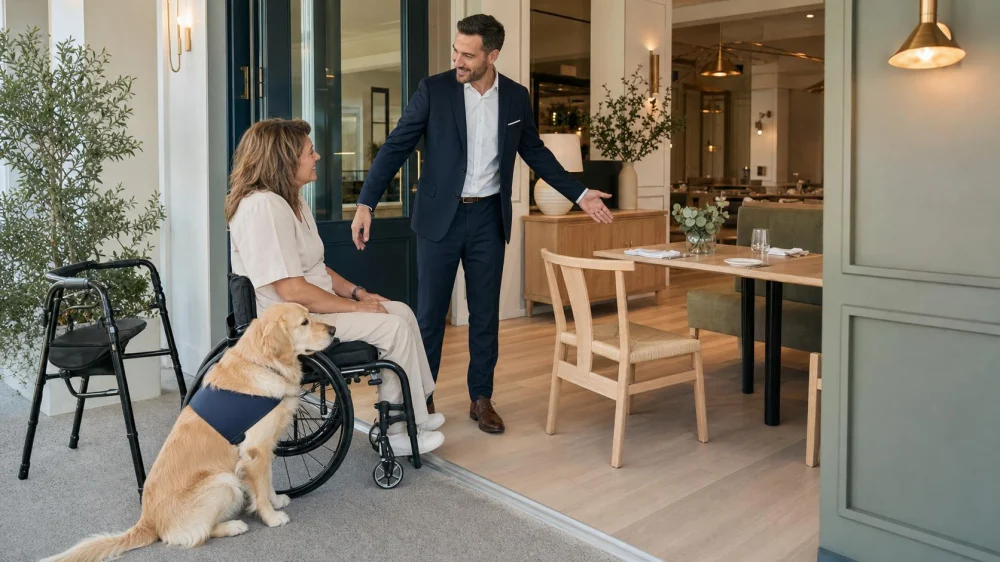
- “I need to keep my service dog under or beside the table.”
- “I need a digital menu compatible with my screen reader.”
- “I need a quieter time and seating away from speakers.”
Give measurements only when helpful, such as mobility-device width or turning need. The restaurant should not require a guest to provide a diagnosis to discuss ordinary access planning.
Confirm the arrival route
Start at the curb, parking space, transit stop, rideshare drop-off, or sidewalk. Ask whether the route is level, ramped, paved, well lit, and free of stairs. Confirm curb cuts, slopes, gates, and distance.
Ask about accessible parking and its access aisle, but verify whether the restaurant controls the lot. A shared shopping center, public garage, valet company, or city may manage it.
If valet is used, ask where a passenger can transfer safely and whether the vehicle’s hand controls, ramp, or mobility equipment require instructions. Do not leave essential medication or device parts in a parked vehicle.
Weather, construction, snow, outdoor furniture, delivery vehicles, and temporary events can block a route that is normally open. Reconfirm on the day.
Ask about the entrance
Confirm the accessible entrance location, door type, threshold, opening width, and whether staff assistance is available. If it is not the main entrance, ask for clear directions and whether it remains unlocked during your reservation.
A portable ramp is not automatically suitable. The restaurant must assess slope, stability, landing space, door operation, and applicable requirements. Do not accept an improvised board or let staff lift a person in a mobility device.
Ask whether a vestibule, coat rack, host stand, queue, or decorative item narrows the route. A photograph can help when the restaurant is willing, but it does not replace on-site measurement.
Confirm table and aisle space
Ask for a standard-height table rather than a bar or high-top when needed. Confirm knee clearance, chair removal, table base location, and clear approach. Booths may not work for some guests even when the dining room is step-free.
Describe whether the mobility device will remain with the guest. Do not allow staff to move or store a wheelchair, walker, cane, oxygen equipment, or communication device without permission.
Choose a table that keeps aisles and emergency routes open without isolating the guest. Ask whether the service animal can lie safely out of the aisle and whether other diners or rolling carts will pass closely.
For a large party, confirm the accessible place is integrated with the group rather than at a separate table.
Ask about restroom access
Ask whether the restroom is on the same step-free route, which door it uses, and whether the stall, sink, accessories, and maneuvering space meet the guest’s needs. “We have a restroom” is not enough.
Check whether it is single-user or multi-stall, whether an attendant or key is required, and whether storage blocks the route. Ask staff to inspect it before arrival when possible.
If no suitable restroom is available, that may determine whether the meal is practical. A nearby business’s restroom is not a reliable substitute without permission and confirmed access.
Plan communication access
ADA guidance recognizes that businesses open to the public may need appropriate auxiliary aids and services to communicate effectively. The correct aid depends on the situation and person.
Ask about accessible digital or large-print menus, staff willingness to read the menu, written communication, good lighting for lip reading, captioned content, or an interpreter for a complex planned event. Give reasonable advance notice when an aid requires scheduling.
Do not assume a QR code is accessible. Ask for the direct web address, accessible HTML, or another format. A handwritten menu may still need ingredient and price clarification.
For speech disabilities, tell staff the preferred communication method and allow extra time without being rushed.
Discuss sensory and timing needs
Restaurants may have music, crowd noise, kitchen sounds, flashing décor, strong scents, close seating, and unpredictable waits. Ask when the room is usually quieter and whether a table can be placed away from speakers, bar traffic, open kitchen, restroom line, or flickering light.
Request does not mean guarantee. A kitchen alarm, birthday song, blender, or sudden crowd may still occur. Bring personal coping tools that are safe and permitted, and have an exit plan.
Ask whether waiting can occur outdoors, in a vehicle, or by text notification. Confirm that the method is accessible to the guest.
Know the service-animal basics
ADA.gov explains that businesses generally must allow service animals in areas where the public may go, even with a no-pets policy. A service animal is not required to wear a vest.
Restaurant staff may ask only the questions permitted by law when the need is not obvious. The animal generally stays on the floor or is carried as necessary; restaurants are not required to provide a chair, food, or drink for the animal.
The handler controls the animal. Plan a place under or beside the table that avoids the aisle. Do not let other diners pet, feed, or distract the animal.
State or local law may provide additional rights. Emotional-support animals and pets are not treated the same as ADA service animals under federal Title III.
Plan for mobility devices
ADA Title III regulations say public accommodations must permit wheelchairs and manually powered mobility aids in areas open to pedestrians. Other power-driven mobility devices involve an assessment of factors such as device size, speed, facility design, pedestrian traffic, and legitimate safety requirements.
Tell the restaurant the device type and relevant dimensions. Ask about charging only if essential and approved; do not run a cord across an aisle.
Staff should not require a person to transfer to a chair unless necessary for a specific service and lawfully supported. Do not lift or manually reposition a guest or device without consent and safe training.
Verify again on arrival
Call shortly before departure if weather or construction may affect the route. On arrival, identify the reservation and request before joining a queue.
Check the route visually and pause if a temporary obstacle appears. Let staff move furniture; do not ask the guest to squeeze through or move heavy objects.
Confirm the table, restroom route, communication plan, and service-animal space before settling in. Keep mobility equipment within reach.
Handle a mismatch calmly
If the promised route or table is unavailable, explain the exact barrier and ask for the manager. Consider another table, moving a removable obstacle, using an accessible entrance, switching to takeout, or leaving.
Document the date, time, employee, barrier, and response. Do not photograph other guests without consent or argue in an unsafe doorway.
For ADA questions or complaints, consult ADA.gov and the appropriate federal, state, or local agency. A reservation app review is not a substitute for a legal process.
Legal and practical limits
This article is general information, not legal advice. ADA coverage, reasonable modifications, readily achievable barrier removal, effective communication, service animals, building standards, and defenses depend on facts and law.
Contact ADA.gov, a disability-rights organization, or a licensed attorney for individual legal guidance. In an emergency, follow staff and emergency-responder instructions while preserving access needs when possible.
Call-ahead checklist
- Step-free arrival route and entrance
- Door, threshold, and clear width
- Standard-height table, floor space, and aisle
- Accessible restroom route and features
- Menu and communication format
- Quieter timing or sensory placement
- Service-animal floor space
- Mobility-device type and dimensions
- Reservation note, employee, and reconfirmation
Frequently asked questions
Should I ask whether a restaurant is “wheelchair accessible”?
Ask about specific features: route, steps, door, table, clear floor space, aisle, and restroom. A broad yes may hide a barrier.
Can a service dog enter a restaurant?
Generally yes under the ADA in areas open to the public, subject to the law’s service-animal rules. The animal stays controlled and usually on the floor.
Can the restaurant require a service-animal vest?
No. ADA.gov states service animals are not required to wear vests.
What if the only tables are high-tops?
Explain the need for a standard-height accessible table and ask the manager what integrated alternative is available.
Evidence and sources
- ADA.gov: Public accommodations and effective communication
- ADA.gov: Service animals
- ADA.gov: Title III regulations, including mobility devices
Next steps
Write down the three access features that determine whether the meal works. Call the exact location, ask an employee to verify each one, and add the details to the reservation.
Reconfirm on the day, especially after weather, construction, or a layout change.





 Pies 'n' Thighs4.0 (3663 reviews)
 Stamford Hospital Cafeteria2.0 (5 reviews)
 New Sin Lee3.0 (58 reviews)
 The Theater Buffet3.0 (124 reviews)
 TA Cafe0.0 (0 reviews)
 COOL ICE4.0 (65 reviews)
 How Ice Cream Shops Are Highlighting Nostalgic Flavors With Modern Twists
 Top 5 Ethnic Restaurants Near Me That Will Take Your Taste Buds on a Global Journey
 How Breakfast Restaurants Are Experimenting With Global Flavors and Ingredients
 How to Find the Best Brunch Buffets Near Me: A Food Lover’s Dream Come True
 Discover the Best Pizza Restaurants That Experiment With Creative Toppings and Styles
 How Middle Eastern Restaurants Are Attracting International Audiences | Global Cuisine Trends