
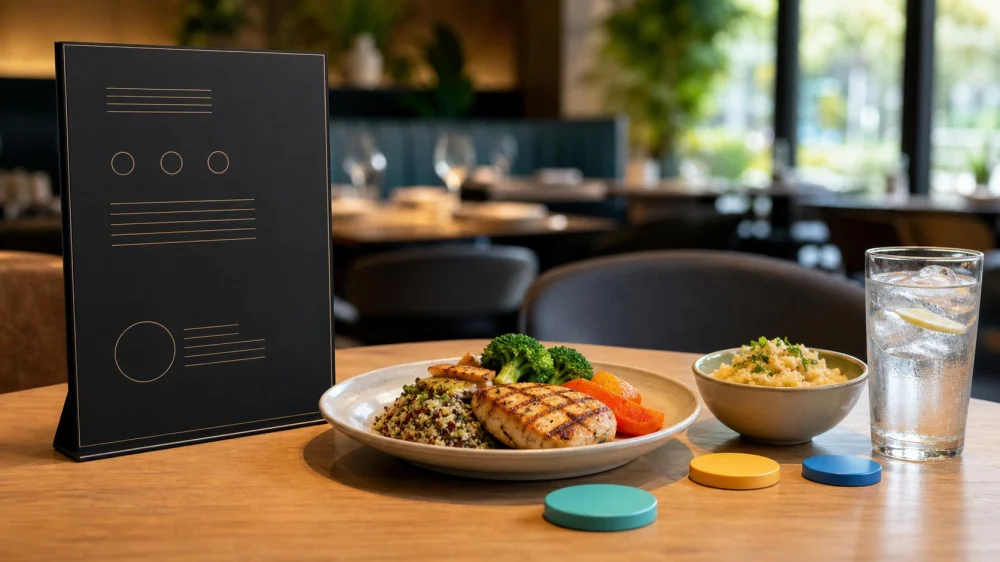
Restaurant Menu Calories: Read the Number in Context
On this page
- Quick answer
- Where calorie labels appear
- Understand a standard menu item
- Account for customizations
- Read ranges and combinations
- Request more nutrition information
- Use calories with personal goals
- Build a practical ordering method
- Menu calorie checklist
- Frequently asked questions
- Sources and evidence notes
- Conclusion and next steps
Quick answer
A calorie number on a restaurant menu describes the listed standard item, not necessarily the exact plate after size changes, sides, sauces, drinks, refills, or substitutions. Match the number to the precise item and portion, then account for everything added or removed. Use it as one planning input alongside hunger, dietary needs, ingredients, and the rest of the day.
FDA’s federal menu-labeling rule generally covers restaurants and similar retail food establishments that are part of a chain with 20 or more locations, operate under the same name, and offer substantially the same menu items. Independent restaurants may provide information voluntarily or under other rules, so the absence of posted calories does not itself signal anything about food quality.
Where calorie labels appear
At covered establishments, calories for standard menu items appear on menus and menu boards. Calories for standard self-service foods and foods on display should be placed close to and clearly associated with the item. Digital ordering screens and drive-through boards can show the same information in different layouts.
Look for the item name, portion, size, and calorie number as a unit. A number positioned between two products can be easy to misread. Ask staff which item it belongs to rather than guessing. Temporary specials, custom orders, daily specials, condiments for general use, and some other foods may be treated differently under the rule.

Understand a standard menu item
A standard menu item is routinely offered and prepared in a substantially consistent way. The posted calories refer to that standard build. If a sandwich normally includes cheese, spread, and a particular side, determine whether those components are included in the displayed number.
Portion wording matters. Compare single and double patties, cup and bowl, slice and whole pie, lunch and dinner portions, or small and large beverages. Do not assume a shared appetizer number is “per person” or that an entrée number includes every side shown in a photo. The menu’s footnotes and written nutrition material should clarify the basis.
Account for customizations
Add-ons and substitutions can change calories. Dressings, cooking oils, cheese, sauces, cream, sweeteners, toppings, and larger bases are common examples. Removing one ingredient may lower the total, but preparation methods and fixed components remain. Ask for the nutrition information for available choices when the decision matters.
Customization displays may update the total as selections change; verify the final cart rather than the starting item. If the system shows a range, determine which options create the low and high ends. A request such as “light sauce” may not have a standardized measured amount, so treat its effect as uncertain.
Read ranges and combinations
A range can represent flavors, sizes, toppings, or possible combinations. It does not mean every version is the midpoint. For a build-your-own meal, add the values for the selected base, protein, toppings, dressing, side, and beverage when the restaurant provides components.
Combination meals deserve a line-by-line check. The displayed total may assume one side and drink size while the order uses another. Refills and shared starters are easy to overlook if the goal is to estimate personal intake. Divide only when the portion was actually shared, and remember that restaurant serving pieces may not split evenly.
Request more nutrition information
Covered establishments must make additional written nutrition information available on request for standard menu items. FDA identifies details including total fat, saturated fat, trans fat, cholesterol, sodium, total carbohydrate, dietary fiber, total sugars, added sugars, and protein. Ask how to access the current information in print or digitally.
Calories do not reveal allergens, gluten status, sodium, carbohydrate distribution, fiber, or ingredient compatibility. Use the relevant information for diabetes management, kidney or heart conditions, food allergies, pregnancy, medication interactions, or another clinical diet, and follow advice from the person’s healthcare professional.
Use calories with personal goals
The menu statement that 2,000 calories a day is used for general nutrition advice also says individual needs vary. Age, body size, activity, pregnancy, health conditions, and clinical goals affect needs. The number is context, not a score of whether a food is “good” or “bad.”
A practical choice might focus on portion size, vegetables, protein, fiber, sodium, enjoyment, or predictability rather than selecting the lowest number. People recovering from an eating disorder or following a clinician-guided plan may need to avoid calorie-focused decision making; use the care team’s approach.
Build a practical ordering method
- Identify the exact item and portion size.
- Check what is included in the posted number.
- Review ranges, footnotes, and combination assumptions.
- Add chosen sides, drinks, toppings, and sauces.
- Request written nutrition information when relevant.
- Check allergen and ingredient needs separately.
- Choose a portion and meal balance that fit personal goals.
- Review the final digital cart before payment.
If information is unclear, ask one specific question at a time, such as whether the dressing or side is included. Clear questions are easier for staff to verify.
Menu calorie checklist
- Match the number to the exact item and size.
- Confirm whether sides and sauces are included.
- Interpret ranges through available options.
- Account for beverages, refills, and add-ons.
- Review the final customized order.
- Request additional written nutrition details.
- Check allergens and ingredients separately.
- Use 2,000 calories only as general context.
- Follow any clinician-directed nutrition plan.
Frequently asked questions
Why do some restaurants show no calories?
The federal rule applies to qualifying chains; other establishments may not be covered or may provide information voluntarily.
Does the number include the side?
It depends on the menu presentation. Check footnotes or ask which standard components are included.
What does a calorie range mean?
It can reflect sizes, flavors, toppings, or combinations. Identify the values for your selected options.
Are customized orders exact?
Posted information is based on standard recipes and portions; variable preparation can create real-world differences.
Can calories identify allergens?
No. Use the restaurant’s allergen and ingredient process separately.
Can I ask for sodium or carbohydrate information?
Covered establishments must provide additional written nutrition information for standard items on request.
Sources and evidence notes
The U.S. Food and Drug Administration’s Menu Labeling Requirements explains coverage for qualifying chains, calorie disclosure for standard items, self-service placement, the general 2,000-calorie statement, and access to additional written nutrition information. FDA’s overview provides consumer context for the rule.
Local requirements and restaurant practices may add information. The restaurant’s current menu and nutrition documentation govern its specific items.
Conclusion and next steps
Read a menu calorie number as the starting point for a defined standard item. Match the portion, account for every selected component, request more nutrition details when needed, and check allergens separately. Then place the number in the context of the individual rather than treating it as the whole meal decision.





 Maretta4.0 (186 reviews)
 Mama Fina's4.0 (479 reviews)
 Dely y Taqueria Katy4.0 (4 reviews)
 Alegria Dominicana Restaurant4.0 (226 reviews)
 Omelettos5.0 (81 reviews)
 Popeyes Louisiana Kitchen4.0 (1730 reviews)
 The Appeal of Tea Houses as Modern Relaxation Spots: Why They're Trending in the U.S.
 How to Find the Best Mediterranean Fast Food Near Me: Quick, Healthy, and Delicious
 How Indian Restaurants Are Popularizing Regional Flavors
 Where to Find the Best Gravy Near Me: Where to Savor Rich and Flavorful Sauces
 Best Vegan Chocolate Shops Near Me: Satisfy Your Sweet Tooth Without Dairy
 Finding the Best Churro Shops Near Me Serving Fresh Fried Dough with Cinnamon Sugar