
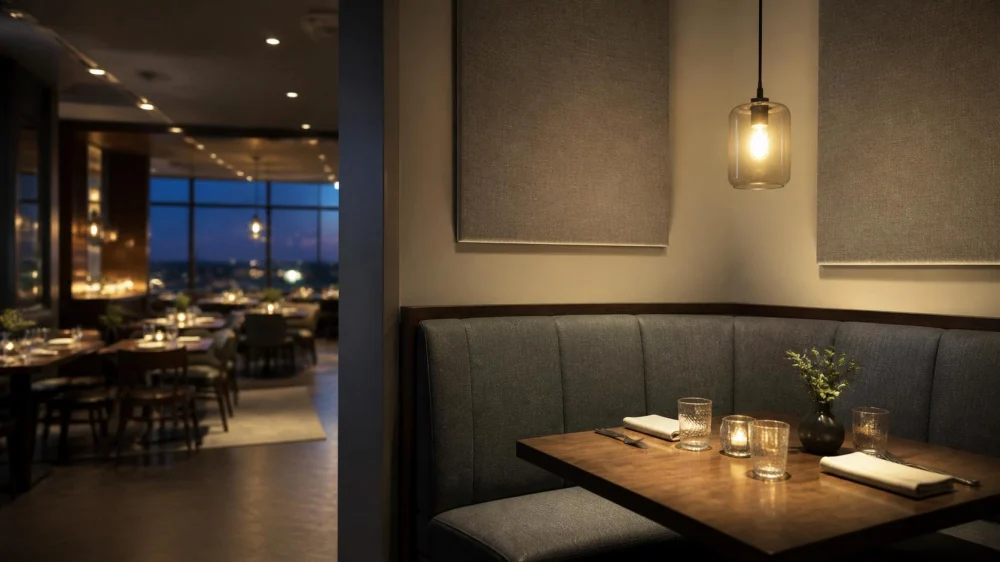
Restaurant Noise Level: Check the Sound Before You Book
Table of contents
Quick answer
A restaurant's sound level can change dramatically by day, time, room, and crowd. Before booking, call during a non-rush period and ask which seating area is usually easiest for conversation. Request a table away from speakers, bars, kitchens, and large parties. Treat online comments as clues rather than guarantees, then confirm the request when you arrive.

Why restaurant noise varies
“Quiet” and “loud” are not fixed restaurant categories. A dining room that feels calm at 5:30 p.m. may become energetic by 8:00 p.m. Music volume, hard surfaces, ceiling height, table spacing, open kitchens, busy bars, and the number of guests all influence what you hear. Patios can be peaceful one evening and dominated by traffic, wind, live music, or nearby events on another.
Your group also matters. Two people seated close together may converse comfortably in a room that is difficult for six people around a long table. A guest with hearing loss, tinnitus, sound sensitivity, auditory processing challenges, or hearing aids may experience the same room very differently from other diners. The useful question is therefore not simply “Is this restaurant noisy?” but “Which setting, time, and table best fit this group?”
Restaurants may intentionally create a lively atmosphere, and staff cannot always change music or control neighboring conversations. A specific seating request is generally more actionable than a broad demand for silence. Give the host enough information to help without expecting a guarantee that depends on the crowd.
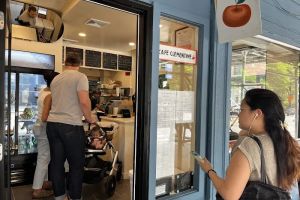
Cafe Clementine / cafe clementine nyc
New YorkNew York CountyNew York
325 Greenwich St, New York, NY 10013, USA
Check before booking
Start with the restaurant's own website and reservation page. Photos can reveal a bar-focused room, an open kitchen, communal tables, upholstered booths, private rooms, patios, or multiple dining areas. Event calendars may identify live music, trivia, game nights, or private functions. These details do not measure sound, but they help you ask better questions.
Read recent reviews for repeated observations, not a single dramatic comment. Search within reviews for words such as “noise,” “music,” “conversation,” “bar,” “patio,” and “quiet.” Pay attention to the date and dining time. A lunchtime review from winter may say little about a packed summer patio on Friday night.
Call outside the lunch or dinner rush. Describe your actual need: “We have four guests and one uses hearing aids. Which area is usually best for conversation around 6 p.m. on Tuesday?” Staff may know that a back room, booth, patio corner, or early seating tends to work better. Ask whether the restaurant can note a preference on the reservation and whether an event is scheduled that evening.
Useful questions include:
- Do you have more than one dining room?
- Is music amplified, and is live entertainment scheduled?
- Which tables are farthest from speakers, the bar, and kitchen pass?
- Are booths or wall-side tables available?
- When does the room usually become busiest?
- Could a seating preference be added to the reservation notes?
If conversation is the main purpose of the meal, an earlier reservation often offers more flexibility. However, do not assume that every early seating will be quiet; happy hour, sports broadcasts, family dining periods, and special events can create different patterns.
Ask for a quieter table
Make the request when booking and repeat it politely at check-in. Reservation notes can be missed, and the exact table mix changes throughout service. Say what would help: a booth, a wall-side seat, distance from speakers, or separation from the bar. “A quiet table if possible” is useful, but adding one concrete preference gives the host more options.
Some locations assign tables in advance; others decide as guests arrive. A request is not a confirmed accommodation unless the restaurant explicitly says so. If the best table requires a short wait, decide whether sound or schedule matters more that day. The host may also offer a different room or outdoor table.
Before settling in, take a brief listen. If the table is clearly unsuitable, ask immediately whether another available location would be better. Moving is easier before drinks and food arrive. Avoid pointing at or blaming nearby guests; describe the environmental issue and the desired alternative.
Seat strategically when a move is impossible. A guest who needs clearer speech may benefit from facing the group, seeing facial expressions, and sitting with their back toward a wall rather than toward the center of the room. Keep the person who has the most difficulty away from speakers and the noisiest traffic path.
Manage the meal
Small choices can make conversation easier without changing the restaurant. Keep the group compact rather than spreading across a long table. Reduce competing audio from phones. Ask one person to speak at a time when discussing important information. Make eye contact before speaking, and avoid covering your mouth. If menus are being discussed, point to the item so names and prices do not need to be repeated over the room.
For a business meal or sensitive conversation, create a backup plan. Put detailed discussion before the restaurant, move it to a quieter location afterward, or share key information in writing. A bustling dining room offers little privacy even when individual words are hard to hear.
If volume rises during the meal, a courteous question to staff is reasonable: “Would another table be quieter, or is there a calmer area available?” Staff may be unable to relocate a fully seated group, and music policies differ. Keep the request focused on possible solutions.
Consider the full experience, not only decibels. Dim lighting can make lip reading harder. Closely spaced tables may increase distraction. Tall centerpieces can block faces. A quieter patio may introduce weather or accessibility concerns. The best table is the one that balances conversation, comfort, mobility, temperature, and service for your party.
Accessibility and safety
If a guest has a disability-related communication need, contact the restaurant in advance and clearly describe the practical support requested. Needs vary, so avoid assuming that a generic “accessible table” solves a hearing or sensory issue. A seating location, written clarification, extra time, or another reasonable communication method may be more helpful.
Do not ask a guest to remove or adjust a hearing device unless they choose to do so. Hearing aids can amplify surrounding sound as well as speech, and settings are personal. Let the person identify what helps. If a sudden sound causes pain, distress, dizziness, or another health concern, leave the environment and seek appropriate medical guidance rather than trying to push through the meal.
Personal sound-meter apps can provide rough comparisons between spots, but consumer phones are not calibrated professional instruments. Do not use an app reading to declare a venue legally safe or unsafe. For occupational exposure questions or persistent hearing symptoms, consult a qualified professional.
Limitations
No call, photo, review, or reservation note can guarantee a particular sound level. Staffing, parties, weather, equipment, entertainment, and guest behavior can change without notice. Even tables in the same room can feel different. Online reviews are subjective and may describe an old layout or former music policy.
This guide is for dining planning, not medical, legal, or acoustic advice. Hearing and sensory needs are individual. Local accessibility duties and restaurant practices vary. Confirm important arrangements directly with the venue and seek specialized guidance when health or formal accommodation questions are involved.
Frequently asked questions
What is the quietest time to visit a restaurant?
Often it is shortly after opening or during an off-peak weekday period, but the pattern depends on the venue. Happy hour, brunch, sports, and live events can reverse the usual assumption. Ask staff about the specific day you plan to visit.
Is a booth always quieter than a table?
No. Upholstered booths and walls may reduce some reflected sound, but a booth beside a speaker, bar, kitchen, or large party can still be loud. Location matters more than the seating label alone.
Should I ask the restaurant to turn down the music?
You may ask politely, but the restaurant may maintain one level for the whole room. A table change, different dining area, or earlier visit is often a more workable request.
Can reviews reliably identify quiet restaurants?
Reviews are useful when many recent diners describe the same pattern and include a day or time. They remain subjective and cannot predict the crowd, table, or event during your meal.
What should I put in a reservation note?
Keep it specific and brief: “Guest uses hearing aids; please seat us away from speakers and the bar if possible.” Call as well when the request is important, because notes are preferences unless confirmed.
What if the restaurant cannot meet the request?
Ask about another time, room, table, takeout, or nearby sister location. If comfortable communication is essential and no suitable option exists, choosing a different venue is a reasonable decision.
Conclusion
A productive noise-level check combines recent clues with a direct, specific conversation. Ask about the exact day and time, request a table away from predictable sound sources, and confirm at arrival. Build in flexibility because restaurant conditions change. Clear expectations and a backup plan give your group the best chance of enjoying both the meal and the conversation.






 Green Basket Deli4.0 (83 reviews)
 Balzem4.0 (981 reviews)
 Juice Generation4.0 (240 reviews)
 Lalito4.0 (200 reviews)
 Mana Spanish Food4.0 (106 reviews)
 Wabi Sabi4.0 (358 reviews)
 htmlCopy codeHow Asian Restaurants Are Blending Traditional Flavors With Modern Twists
 How to Find the Best Mediterranean Fast Food Near Me: Quick, Healthy, and Delicious
 A Complete Guide to Finding Mongolian Restaurants Near Me With Custom Stir Fry Bowls
 How Mediterranean Restaurants Are Balancing Flavor and Health
 Best Sushi with Spicy Tuna Rolls Near Me: Creative Picks
 Exploring Dessert Restaurants That Combine Art and Flavor